Showing posts with label Life Skills. Show all posts

Friday, August 28, 2026

Understanding Leadership as Vocation

by Alan S. Cajes, PhD

In an era marked by institutional fragility, systemic complexity, and a pervasive crisis of meaning, "Leadership as Vocation: Saying Yes to a Life Beyond Position and Power" articulates an integrative framework that reframes leadership not as a managerial technique to be mastered, a career to be pursued, or a position to be claimed, but as a lifelong moral, relational, and psychological calling. Moving beyond traditional paradigms bound by formal authority, performance metrics, and technical expertise, the text demonstrates that leadership legitimacy in volatile environments depends fundamentally on inner moral grounding, emotional maturity, and relational trust. At the heart of this work is the "Lifelong Yes"—a sustained, freely renewed acceptance of responsibility for others, institutions, and the common good across seasons of clarity, struggle, failure, and transition. 

Grounded in conscious dialogue with classical virtue ethics, existential psychology, systems thinking, and adaptive leadership theory, the framework derives its unique ethical realism from Filipino philosophical anthropology. Concepts such as "loob" (the inner moral self), "kapwa" (shared personhood), "bayanihan" (communal agency), "malasakit" (compassionate concern), "tatag ng loob" (inner fortitude), and "pananagutan" (accountability) are engaged not as cultural ornamentation, but as substantive philosophical resources that illuminate leadership as relational stewardship and ethical endurance. 

The book synthesizes these traditions across four essential dimensions: 

- Formation and Psychological Maturity: Demonstrates that leadership begins beyond minimum formal qualifications through the intentional formation of "loob", elevating self-awareness, self-governance, and emotional attunement (pakikiramdam) into public ethical duties rather than optional self-care. 

-Relational Stewardship and the Common Good: Reframes vision and sense-making as communal, interpretive acts, positioning trust, psychological safety, and servant leadership (paglilingkod) as the true foundations of institutional legitimacy. 

-Adaptive Courage and Practical Wisdom: Distinguishes technical problems from adaptive challenges, emphasizing moral courage, restraint (applying the brakes), and practical judgment (phronesis) to ensure orientation precedes optimization when navigating complex systems. 

-Moral Resilience and Generative Legacy: Reinterprets failure as a formative site for moral growth and renewal, calling leaders away from self-preservation toward institutional stewardship, mentorship, deliberate succession, and intergenerational responsibility. 

Ultimately, "Leadership as Vocation" shifts the horizon of leadership scholarship from short-term performance, individual ambition, and transactional influence toward character, fidelity, and enduring service, providing scholars, public servants, and practitioners with a profound vocabulary for leading with moral courage and human dignity.

Click to read

Sunday, April 5, 2026

Ikigai, Loob, and the Filipino Architecture of Purpose: A Reflective Synthesis on Self, Work, and Meaning

 by Alan S. Cajes

The Japanese concept of ikigai—often translated as “a reason for being”—invites a simple inquiry: Why do we wake up in the morning? It frames purpose as the convergence of four domains: what we love, what we are good at, what the world needs, and what we can be sustained by economically. Yet, as compelling as this framework is, its deeper philosophical significance emerges only when situated within a broader anthropology of the self.

The text reminds us that ikigai is not the discovery of a singular, grand destiny, but the cultivation of meaning in the ordinary rhythms of life—helping others, mastering a craft, contributing quietly yet meaningfully. In this sense, ikigai is less an endpoint than a discipline of alignment.

However, within the Filipino philosophical tradition, this alignment is not merely structural—it is relational, moral, and ontological.

Loob as the Source of Purpose

If ikigai asks what one loves and what one is good at, Filipino thought locates these not in isolated preferences, but in Loob—the inner self that carries intention, integrity, and moral depth.

To act from Loob is to act from a unified self (buo ang loob), where passion and skill are not fragmented expressions but coherent manifestations of being. Here, purpose is not constructed externally; it is unfolded from within.

This resonates with the proposition that being subsists under the conditions that allow it to flourish. Purpose, therefore, is not imposed—it is enabled.

Kapwa and the Social Nature of Meaning

The dimension of ikigai that asks “what the world needs” finds its profound counterpart in Kapwa—the Filipino concept of shared personhood or identity.

In this view, the self is never solitary. One’s purpose is not an individual achievement but a relational fulfillment. The good of the self is inseparable from the good of others.

Thus, ikigai becomes more than personal alignment—it becomes ethical participation in a shared world.

This aligns with Amartya Sen’s notion of development as expanding capabilities, not merely for oneself, but in ways that reduce “unfreedoms” for others. Purpose, then, is realized not in isolation, but in solidarity.

Galing as Cultivated Capability

“What you are good at” in ikigai is elevated in Filipino thought through Galing—not just competence, but excellence honed for meaningful contribution.

Here, talent is not accidental; it is responsibility. To develop one’s abilities is to prepare oneself to serve.

This reflects a crucial insight: Capability without direction is potential unrealized; capability aligned with purpose becomes transformative.

Dangal and the Integrity of Work

The economic dimension of ikigai—what one can be paid for—is often interpreted pragmatically. Yet, within Filipino values, it is reframed through Dangal—dignity, honor, and moral integrity.

Livelihood is not merely transactional; it is ethical expression. Work becomes meaningful not only because it sustains life, but because it does not betray the self.

Thus, the question is not simply: Can I be paid for this?
But rather: Can I live with myself doing this?

Harmony of Inner and Outer Worlds

When Loob, Kapwa, Galing, and Dangal align with the four dimensions of ikigai, the result is not merely productivity or success—it is Kaginhawaan.

Kaginhawaan is a state of holistic well-being where the inner self is at peace, where one’s work contributes meaningfully to others, where livelihood sustains without corrupting, and where life is experienced as coherent and purposeful.

It is, in essence, the Filipino articulation of a life well-lived.

Implications for Self-Awareness

For the contemporary professional—especially in contexts shaped by rapid change, external pressures, and fragmented identities—this synthesis offers a critical reorientation:

  • From career-building to self-integration;
  • From networking to relational responsibility (Kapwa);
  • From skills acquisition to purposeful excellence (Galing); and
  • From income generation to dignified livelihood (Dangal).

Above all, it calls for a return to Loob—the inner compass that anchors action in authenticity.

Purpose as Alignment

Ikigai, when viewed through a Filipino philosophical lens, is no longer just a diagram of intersecting circles. It becomes an architecture of being—where inner coherence, social responsibility, cultivated excellence, and ethical livelihood converge.

Purpose, then, is not something we find once and for all.
It is something we live into, daily—
in the quiet alignment of who we are, what we do, and whom we serve.

Sunday, May 25, 2025

Learning from the Past and the Future

by Alan S. Cajes 

During a special forum with C. Otto Scharmer on May 24, 2019 in Manila, I took part in an intimate sharing session on the topic "Thriving in the Age of Disruption: The Emergence of the Eco-System Leader." It also served as an opportunity to discuss some ideas with Scharmer related to his Theory U. In his book entitled "The Essentials of Theory U," Scharmer shares some insights on learning. He said: "There are two different sources of learning: (1) learning by reflecting on the past and (2) learning by sensing and actualizing emerging future possibilities." These distinct sources of learning are crucial for personal and organizational development. 

In an era of accelerating VUCA change, leaders and organizations face a fundamental challenge: how do we learn effectively when both the pace of change and the volume of information exceed our traditional processing capabilities? The answer may lie in recognizing that human learning operates through two complementary yet distinct modalities that have been understood for millennia, but are only now being validated by contemporary neuroscience. 

Two Sources of Learning 

Effective learning draws from two primary sources that together create a complete epistemological framework: 

• Learning from Yesterday: Retrospective Analysis - This involves the systematic examination of past experiences and outcomes to extract patterns, principles, and insights. Through careful analysis of both successes and failures, individuals and organizations build a repository of practical wisdom that informs future decision-making. 

This mode of learning emphasizes empirical observation, pattern recognition, and the gradual accumulation of knowledge through experience. 

• Learning from Tomorrow: Prospective Sensing - This forward-looking approach involves developing sensitivity to emerging trends, nascent possibilities, and future potentials that have not yet fully materialized. Rather than extrapolating from past data, this mode requires cultivating the capacity to perceive weak signals, recognize emerging patterns, and engage with possibilities that exist at the edge of current reality. 

The integration of these two approaches creates a dynamic learning system that honors accumulated wisdom while remaining open to transformative possibilities. 

Classical Philosophical Foundations 

This dual epistemological framework finds profound resonance in the foundational works of Western philosophy, suggesting that the recognition of multiple learning modalities has ancient roots. 

• Platonic Epistemology: The Divided Line of Knowledge - Plato's epistemology, most fully developed in the Republic and Meno, distinguished between knowledge acquired through sensory experience (doxa) and the deeper understanding that emerges through recollection (anamnesis). In the famous dialogue with the slave boy, 

Plato demonstrates how genuine mathematical insight arises not from external instruction but from the soul's recognition of eternal truths it encountered before birth. This Platonic insight parallels our contemporary understanding of prospective sensing: sometimes we recognize emerging truths not through analytical deduction but through a deeper form of recognition that transcends ordinary reasoning. The capacity to sense future possibilities may operate through similar mechanisms of recognition rather than calculation. 

• Aristotelian Empiricism: From Sensation to Wisdom - Aristotle's Posterior Analytics and Nicomachean Ethics established the empirical foundation that would later influence Aquinas and shape Western scientific methodology. His epistemological hierarchy—from sensation (aisthesis) through experience (empeiria) to scientific knowledge (episteme) and wisdom (sophia)—provides a systematic framework for learning from accumulated experience. However, 

Aristotle also recognized nous (intuitive intellect) as the faculty that grasps first principles directly, without demonstration. This suggests that even within his empirical framework, Aristotle acknowledged forms of immediate insight that complement gradual learning from experience. 

• Thomistic Synthesis: Natural and Supernatural Knowledge Thomas Aquinas, in the Summa Theologica and De Veritate, achieved a remarkable synthesis of Aristotelian empiricism with Christian theological insights. His distinction between natural knowledge (acquired through sensory experience and rational analysis) and supernatural knowledge (received through divine infusion) provides a framework for understanding both methodical learning from experience and the more mysterious process of breakthrough insight. 

Aquinas's concept of infused knowledge—understanding that arrives complete and transformative rather than through gradual accumulation—offers a medieval parallel to contemporary research on insight and intuitive cognition. 

Contemporary Neuroscientific Validation 

Modern neuroscience provides compelling empirical support for these philosophical distinctions, revealing the specific brain mechanisms that underlie both retrospective analysis and prospective sensing. 

Memory Consolidation and Retrospective Learning. - Research in cognitive neuroscience has illuminated the biological basis of learning from experience. The hippocampus plays a crucial role in consolidating memories during sleep, strengthening synaptic connections and integrating new information with existing knowledge structures (Squire & Kandel, 2009). This process of memory consolidation literally rewrites our neural architecture, allowing us to extract increasingly sophisticated patterns from accumulated experience. 

Studies of expertise development show how deliberate practice creates domain-specific neural networks that enable rapid pattern recognition and skilled performance (Ericsson & Pool, 2016). This research validates the importance of systematic reflection on past experience as a foundation for developing practical wisdom. 

Predictive Processing and Future Sensing. - Emerging research on predictive processing reveals that the brain is fundamentally a prediction machine, constantly generating models of future possibilities (Clark, 2016). The default mode network—a collection of brain regions active during rest—engages in extensive mental time travel, simulating potential scenarios and preparing responses to anticipated events (Buckner & Carroll, 2007). 

This neurological capacity for "learning from tomorrow" involves the prefrontal cortex's ability to integrate weak signals into coherent anticipatory frameworks. Recent studies suggest that individuals with stronger default mode network connectivity show enhanced capacity for creative insight and future-oriented thinking. 

Intuitive Cognition and Rapid Pattern Recognition.- Research on intuitive decision-making has revealed how the brain processes complex information below conscious awareness. Antoine Bechara's landmark studies using the Iowa Gambling Task demonstrated that participants develop physiological responses to advantageous choices before they can consciously articulate the underlying patterns (Bechara et al., 1997). 

This research on "somatic markers" suggests that our capacity to sense emerging possibilities operates through rapid, unconscious pattern matching that precedes analytical reasoning. The brain's ability to detect subtle patterns and generate intuitive responses provides a neurological foundation for prospective sensing. 

Insight and Neural Reorganization. - Neuroimaging studies of insight experiences reveal that breakthrough moments involve the sudden reorganization of neural networks. The "Aha!" experience appears in EEG recordings as distinctive gamma wave bursts, suggesting that transformative learning occurs when the brain rapidly reconfigures existing knowledge into novel patterns (Jung-Beeman et al., 2004). 

These findings indicate that both retrospective reflection and prospective sensing can trigger insight experiences, validating the integration of both learning modalities as neurologically grounded approaches to understanding. 

Implications for Leadership and Organizational Learning 

This convergence of ancient wisdom and contemporary science suggests several important implications for how we approach learning in complex, rapidly changing environments: Balanced Learning Portfolios: Effective leaders and organizations need to cultivate both retrospective analytical capabilities and prospective sensing abilities. This requires creating structures and practices that support both systematic reflection on experience and openness to emerging possibilities. 

• Multiple Ways of Knowing: Recognizing the validity of both analytical and intuitive forms of cognition can help leaders make better decisions in uncertain environments. The integration of data-driven analysis with pattern sensing and intuitive insight creates a more robust decision-making framework. 

• Contemplative Leadership: The cultivation of prospective sensing may require practices that quiet the analytical mind and create space for subtle pattern recognition. This suggests the importance of contemplative practices in leadership development. 

Toward an Integrated Epistemology 

The recognition that learning operates through dual modalities—retrospective analysis and prospective sensing—represents more than an interesting theoretical insight. It points toward a more complete understanding of human cognition that honors both the accumulated wisdom of experience and the creative capacity to sense emerging possibilities. 

This integrated approach to learning, supported by both ancient philosophical wisdom and contemporary neuroscientific research, offers a foundation for navigating complexity and uncertainty with both practical grounding and creative responsiveness. In a world where the future increasingly differs from the past, our capacity to learn from both yesterday and tomorrow becomes not just advantageous but essential. 

References

Bechara, A., Damasio, H., Tranel, D., & Damasio, A. R. (1997). Deciding advantageously before knowing the advantageous strategy. Science, 275(5304), 1293-1295.

Buckner, R. L., & Carroll, D. C. (2007). Self-projection and the brain. Trends in Cognitive Sciences, 11(2), 49-57.

Clark, A. (2016). Surfing uncertainty: Prediction, action, and the embodied mind. Oxford University Press.

Ericsson, A., & Pool, R. (2016). Peak: Secrets from the new science of expertise. Houghton Mifflin Harcourt.

Jung-Beeman, M., Bowden, E. M., Haberman, J., Frymiare, J. L., Arambel-Liu, S., Greenblatt, R., ... & Kounios, J. (2004). Neural activity when people solve verbal problems with insight. PLoS Biology, 2(4), e97.

Squire, L. R., & Kandel, E. R. (2009). Memory: From mind to molecules. Scientific American Library.


Friday, March 28, 2025

Choosing Honest Leaders: Your Guide to Understanding Good Governance

by Alan S. Cajes

What Is a Good Leader?

A good leader is not just someone who delivers speeches and makes promises. No—they are a guardian of trust, a servant of the people, and a champion of justice. A good leader:

· Places the people’s needs above their own

· Leads with honesty, fairness, and purpose

· Guards public resources as if they were sacred

· Wages war against corruption, without fear or favor

· Stands for all—not just the powerful few

The Heart of Good Leadership: Integrity and Ethics

What Is Integrity?

Integrity is the soul of leadership. It means:

· Telling the truth—especially when it's inconvenient

· Doing what’s right—even when no one is watching

· Keeping promises—not just making them

· Walking the talk—always

· Holding onto strong moral values like a lighthouse in the storm

 Ethical Leadership Means:

· Treating all people with fairness and dignity

· Refusing to exploit power for personal gain

· Being open, honest, and accountable

· Owning up to mistakes—and growing from them

· Upholding the rights and voices of everyone

The 10 Commandments of Good Governance

 1. Accountability

Great leaders face the people—they don’t hide. They answer tough questions, own their decisions, and welcome scrutiny.
Good Sign: They speak plainly, respond clearly, and take responsibility.
 

2. Transparency
Nothing to hide, nothing to fear. Transparency is the light that reveals the truth.
Good Sign: You know what they’re doing, how they’re doing it, and why.
 

3. Fighting Corruption
They don’t just reject corruption—they crush it.
Good Sign: They don’t flinch at cleaning up dirty systems and exposing the rot.
 

4. Fair Representation
They are the voice of the many, not a mouthpiece for the few.
Good Sign: They listen, learn, and lead with empathy.
 

5. Rule of Law
They are not above the law—they are its humble servant.
Good Sign: They respect human rights, follow due process, and treat everyone equally.
 

6. Responsiveness
A true leader hears your cry—and answers it.
Good Sign: They don’t make excuses. They act.
 

7. Strategic Planning
They see beyond tomorrow. Vision guides them, not impulse.
Good Sign: Their plans make sense, and they have the courage to follow through.
 

8. Efficient Resource Management
They treat public funds as if every coin were their own—because it is.
Good Sign: Budgets that uplift, not enrich. Spending that reflects service, not self-interest.
 

9. Participation and Inclusion
They don’t just speak—they listen. They don’t rule alone—they lead with you.
Good Sign: Community forums, diverse voices, real conversations.
 

10. Continuous Improvement
They are not afraid to say, “I can do better.”
Good Sign: They evolve. They innovate. They rise after every fall.

Red Flags: Warning Signs of a Dangerous Leader

Beware the leader who:

· Promises the world but offers no path

· Surrounds themselves with cronies

· Bristles when questioned

· Blames, deflects, and deceives

· Hides truth behind closed doors

· Uses power for personal glory

· Bends the law to their will

· Divides instead of unites

How to Check a Leader’s Integrity

1. Listen Closely: Do they speak with clarity and courage? Can they explain their ideas simply? Do they admit what they don’t know?

2. Study the Past: What have they done when no one was watching? Have they walked their talk?

3. Watch Their Actions: Do they lead with compassion? Are their values reflected in what they do—not just what they say?

Your Power as a Voter

No leader is perfect. But the best ones strive. They learn. They listen. They serve.

So be bold. Ask questions. Seek truth. Talk to your neighbors.

Because your vote is your voice, your shield, your fire.

Final Wisdom

A good leader is not just a ruler—they are a guardian of hope, a defender of justice, a builder of futures. They rise not for themselves, but for us all.

So when you choose—choose integrity. Choose courage. Choose a leader who serves, not one who rules.

Because the future doesn’t just happen. It is chosen. By you.

Monday, January 4, 2021

Virtue Ethics in Daily Life

By A. Salces Cajes, PhD

The focus of this article is the sub-field of Ethics called normative ethics (the other fields are metaethics and applied ethics). The objective is to answer the question: How can we use Ethics to ensure that we are doing the right thing? 

Broadly speaking, we can describe Ethics as the art and science of correct doing. It is an art because we can practice or apply it in our daily lives. It is a science since it has a specific body of knowledge and principles that can guide human decisions.

Normative ethics helps us in making a decision about what is right and what is wrong. There are three strategies to do this: one, through duty theories; two, through consequentialist theories, and three, through virtue theories or virtue ethics. This article is about the third strategy.

Some Notes on Duty and Consequentialist Theories

Duty theories, among others, require us to practice The Golden Rule: do to others what you require others to do to you. The negative formulation of this rule states that you should not do to others what you do not want others to do to you. These norms are embodied in two ethical principles: beneficence (do good or be merciful and charitable) and nonmaleficence (avoid evil or do no harm). The references for these principles are human rights, laws, customs, as well as categorical imperatives or obligations, such as justice and fidelity.

Consequentialist theories involve a cost-benefit analysis of the effects of our decisions. Thus a good decision implies that the consequence of a decision is more beneficial compared to the cost or the negative effect. The consequentialist theories cover ethical egoism, ethical altruism, and utilitarianism.

On Virtue Ethics

Virtue refers to attitude and behavior that is consistent with high moral standards. Thus a virtuous person thinks, feels and acts in accordance to the standards of excellence and morality. The natural or four cardinal virtues are prudence, temperance, fortitude, and justice. The Christian theological virtues are faith, hope, and love. In Buddhism, virtue refers to the right view. In Islam, it means righteousness.

One way to become a virtuous person is to practice what Aristotle calls as habits to control human emotions. This can be done by cultivating phronesis —moral or practical wisdom, which aims for the good of society by uncompromisingly pursuing excellence. Thus a phronetic leader is like the Gita’s Perspective of Hinduism, and the sage king of Confucianism who combines wisdom, virtue and authority. Or the King Solomon of the Old Testament who was wise and ethical.

Practical wisdom is a fundamental virtue. It is also known as common sense. Barry Schwartz describes it as doing the right thing, in the right way, at the right time.

How can we cultivate practical wisdom? The good news is that our DNA and RNA enable the transfer of information from one generation to the next. So one way to develop common sense is by introspection or reflection. The other ways include interacting with other people, by working together, by sharing contexts and stories through conversation, by reading books about history and the humanities, etc.

The art of practicing virtue ethics is not an easy task. To use the words of Dag Hammarskjold, it involves the longest journey, which is the journey inwards. As Socrates reminded us: “To know thyself is the beginning of wisdom.” 

The Filipino concept of "loob" can help us in this journey. By listening to, and getting in sync with, our "loob" or will (other translations include inner self, spirit, consciousness), we can be grounded with our core values that can illuminate our process of decision making.

References

Hursthouse, Rosalind and Glen Pettigrove, "Virtue Ethics", The Stanford Encyclopedia of Philosophy (Winter 2018 Edition), Edward N. Zalta (ed.), URL = <https://plato.stanford.edu/archives/win2018/entries/ethics-virtue/>.

“Ethics,” by James Fieser, The Internet Encyclopedia of Philosophy, ISSN 2161-0002, https://www.iep.utm.edu/, today’s date.


Thursday, October 22, 2020

Life Skills of a Sustainable Consumer

by A. Salces Cajes, PhD

I had the opportunity to share in an online forum the life skills of a sustainable consumer. Given the time allotted, I came up with a list as shown in the picture. Let me briefly describe each one of these life skills.

Be a smart and wise spender. This a basic life skill that any one can practice at the earliest possible time. This simply means spending within one's means or income. Since we are now living in a VUCAD  (volatile, uncertain, complex, ambiguous, disruptive) world, our source of income is unstable, to say the least. Spending lower than what one earns is important to manage one's balance sheet. This can be done by applying sound financial management, such as buying only the essential items and saving for the future.

Invest in your future. Saving is not easy, especially if one has trouble making ends meet. But given an opportunity to save, this life skill is a must in preparation for one's future. The life expectancy among Filipinos is about 71 in 2020 compared to about 54 in 1950. Thus we need  safety nets as we advance in age, such as by investing in loan associations or cooperatives that provide higher annual interest earning, getting health insurance, creating a retirement fund, and by leading a healthy lifestyle. 

Chart, histogram

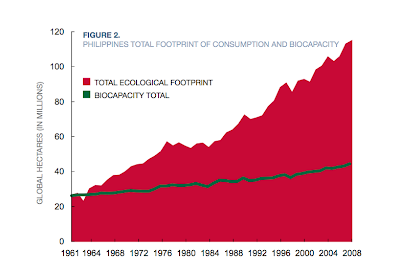
Description automatically generatedReduce your ecological footprint. The country's supply of natural capital (biocapacity) is lower than the population's demand (ecological footprint). Thus, the Philippines has been on an ecological deficit since the 1960s. Our strategy under the new normal should include the "surgical operation" that Atty. Tony Oposa has been advocating -- CPR! This means conserving, protecting and restoring our life systems or natural resources. Some of the ways by which we can practice this life skill is by reducing, reusing and recycling products through zero waste management. Another way is by doing plant-based diet --more food derived from plants and less from animal products.

Practice ecocycle thinking. This is a higher form of life skill that builds on the previous ones. The reference document is nature itself and her laws. Francis Bacon said that "nature to be commanded must first be obeyed." Barry Commoner rephrased this as "nature knows best" in his four laws of ecology. Just as nature recycles every single drop of water, human beings should learn biomimicry to solve human problems. This life skill demands that the materials that society produces should be assimilated by the environment without damaging the natural capacities and services. It also challenges people to use more renewable resources and less non-renewable resources, to avoid stock wastes that require "garbage cemeteries" or landfills, as well as to turn away from a throw-away society that is driven by unbridled consumerism. 

Be a green consumer. Being a green consumer or a green purchaser is a life skill that requires a mindset that favors green products, eco products, products with green labels, organic products or products that have the lowest possible carbon dioxide equivalent footprint in the entire life cycle. As a sustainable consumer, one should avoid "willful ignorance" in choosing and buying items sold in the market place. Consumers have the power to influence the consumption and production patterns into something that approximate the infinity business model.

Invest in natural capital. One can develop this life skill through gardening, natural farming, tree planting, rehabilitating coral reefs, etc. As a sustainable consumer, one can also say no to products that are derived from environmentally destructive activities. At the community level, this can be done through sustainable development approaches like agroforestry, organic agriculture, community forestry, and by protected areas management, such as establishing marine sanctuaries and ecotourism sites. Investing in biocapacity or natural capital is a strategy that complements the reduction in ecological footprint.

Tuesday, October 6, 2020

Life Skill: Compassion

by A. Salces Cajes, PhD

Compassion is hard to practice because our default mode is self protection. Anger occurs as the brain releases catecholamines that trigger a short-term burst of energy. J. Blair (2018) defines anger as “a response to a perceived threat to oneself or to another. It is a response to frustration”.

Anger is neither a pleasant experience nor a proper moment to make decisions. For sure, no one wants to work with an unpleasant person - the bearer of anger. To overcome anger, we redirect (not suppress) it. One way to redirect anger is by distraction — read a book, go to a beach, take care of your plants, or write a letter to the concerned person to express your frustration and then burn the paper or delete your file.

Another way is by reappraisal - listen, check the context, understand the events, etc. Reappraisal can help us become more compassionate. In the process we also train our brain — the supramarginal gyrus of our cerebral cortex — to differentiate our own emotional condition from that of other people. Thus, we have the power to manage anger and the capacity to practice compassion.

Let’s keep in mind Aristotle’s words of wisdom: “Anybody can become angry - that is easy, but to be angry with the right person and to the right degree and at the right time and for the right purpose, and in the right way - that is not within everybody's power and is not easy.”

Thursday, September 24, 2020

Life Skill: Personal Code of Conduct

 A. Salces Cajes, PhD

Also known as the moral code, code of honor, ten commandments or decalogue, the personal code of conduct states the ethical norms that guide you in deciding which decision or action is right or wrong. Such ethical norms represent the standards or ideals that you set for yourself. 

Your code serves as the terms of reference for your conscience when it makes an evaluation about the rightness or wrongness of an action, decision or behavior. If your code is consistent with your credo and values, then you gain confidence in the quality of your choices and actions.

Since your code represents the most sacred character of your being, it has a normative function --it regulates your conduct. In case you  violate your code, your conscience can trigger you to stop, repent or take a positive or affirmative action. It tells you to say sorry or repay an injury that has been done.

If there is such thing as honor among thieves, the right thing to do is for good men and women to have a superior set of moral compass to make this world or our communities, organizations, and homes better places to live in. 

Some examples of a code of conduct include the following:
  • I shall abide by the principle of beneficence or ahimsa by doing good and avoiding evil;
  • I shall protect my personal integrity at all times;
  • I shall observe zero tolerance to corruption;
  • I  shall treat and respect other people as my kapwa.
The True Decalogue by Apolinario Mabini is good source of a code of conduct:

First. Love God and your honor over all things: God, as the source of all truth, all justice and all activity; your honor, the only power that obliges you to be truthful, just and industrious.

Second. Worship God in the form that your conscience that God speaks to you, reproaching you for your misdeeds and applauding you for your good deeds.

Third. Develop the special talents that God has given you, working and studying according to your capabilities, never straying from the path of good and justice, in order to achieve your own perfection, and by this means you will contribute to the progress of humanity: thus you will accomplish the mission that God himself has given you in this life, and achieving this, you will have honor, and having honor, you will be glorifying God.

Fourth. Love your country after God and your honor, and more than you love yourself, because your country is the only paradise that God has given you in this life; the only patrimony of your race; the only inheritance from your ancestors; and the only future of your descendants: because of your country you have life, love and interests; happiness, honor and God.

Fifth. Strive for the happiness of your country before your own, making her the reigning influence for reason, justice and work; if your country is happy, you and your family will also be happy.

Sixth. Strive for the independence of your country, because you alone can have a real interest in her aggrandizement and ennoblement, since here independence will mean your own freedom, her aggrandizement your own perfection, and her ennoblement your own glory and immortality.

Seventh. In your country, do not recognize the authority of any person who has not been elected by you and your compatriots, because all authority comes from God, and as God speaks to the conscience of each individual, the person chosen and proclaimed by the consciences of all the individuals of a whole town is the only one that can exercise real authority.

Eighth. Strive that your country be constituted as a republic, and never as a monarchy: a monarchy empowers one or several families and lays the foundation for a dynasty; a republic ennobles and dignifies a country based on reason, it is great because of its freedom, and is made prosperous and brilliant by dint of work.

Ninth. Love your neighbor as you love yourself, because God has imposed on him and on you the obligation to help one another, and has dictated that he does not do unto you what he does not want you to do unto him; but if your neighbor is remiss in this sacred duty and makes an attempt on your life, your freedom and your priorities, then you should destroy him and crush him, because the supreme law of self preservation must prevail.

Tenth. Always look on your countryman as more than a neighbor: you will find in him a friend, a brother and at least the companion to whom you are tied by only one destiny, by the same happiness and sorrows, and by the same aspirations and interests.

Because of this, while the borders of the nations established and preserved by the egoism of race and of family remain standing, you must remain united to your country in perfect solidarity of views and interests in order to gain strength, not only to combat the common enemy, but also to achieve all the objectives of human life. (http://malacanang.gov.ph/8132-the-true-decalogue-by-apolinario-mabini/)

Friday, September 18, 2020

Life Skill: Statement of Core Values

by A. Salces Cajes, PhD

Your statement of core values naturally flows from the credo. Values are the bases by which you distinguish the right from wrong action. The core values are your “non-negotiables” regardless of the circumstance, time or place. As such, values can be understood as the ethical foundations of human actions, intentions and decisions.

One way of determining your core values is by listing down the major actions or decisions you have made in your life. Review the list and then identify the reasons why you choose such actions or decisions. These reasons are manifestations of your values, i.e., why you do the things you do.

Core values can help students in deciding the kind of future that they will create, the profession that they would like to pursue, or the organization that they would like to work for after graduation. For professionals, core values are determinants in choosing your lifestyle, workstyle, advocacy or friends.

Inventory of Core Values. Come up with a list of three to seven core values or your “non-negotiables”. Describe these core values so that they are clear to you and for other people. Make sure that these values are consistent with your credo. Examples of core values are the following:

· Catholic values: Sanctity of life; Fidelity in relationship

· Mulan (the Movie): Honor; Duty

· Knights (of King Arthur): Courage; Justice

· Leadership: Integrity; Empathy

· Islamic values: Honesty; Kindness

· Filipino values: Hospitality; Loyalty.

 Describe the Core Values.  By describing the core values, you articulate the meaning and implication of these values to yourself and to other people. Examples of descriptions of core value are the following:

·  Jose Rizal, Patriotism: "I wish to show those who deny us Patriotism that we know how to die for our country and convictions."

·  San Miguel Corporation, Sustainable Development: “We advocate sustainable development - We believe in using only what we need and integrating sustainability practices into our operations. Water stewardship, energy optimization and reducing waste are our key environmental priorities.”

·  Author, Obedience or Loyalty: “I will obey and follow the right management instructions to the best of my abilities. I will refuse and oppose instructions that my conscience could not accept.”


Saturday, September 12, 2020

Life Skill: Personal Credo

by A. Salces Cajes, PhD

A personal credo is a set of beliefs guiding your thoughts, behavior, and attitude. It may also consist of principles to live in life. The credo can be distilled from your faith, culture, tradition, upbringing, lessons gained, and experiences.

A credo is important because it serves as one's center of being. When you are exposed to different individuals, groups, experiences and ideas, you will also become susceptible to beliefs and principles that are different from your own.

"Find your center" is a healthy reminder when you are unsure about the decision to make or the action to take. This is especially true when you are confronted with options or temptations that will affect your future. 

In the end, you will have to live and deal with yourself. So, make sure that your personal credo is grounded on ideas and ideals that are consistent with the best available sources of knowledge and wisdom. As a quote, which is attributed to the Vedas, say: "At the center of our being is a truth that shines brighter than a thousand suns."

You may refer to the examples below in crafting your personal credo.
  • I believe in karma -- that good and bad actions will respectively yield positive or negative consequences to me in the near or far future. -- Author
  • I believe in the inherent goodness of human beings, the beauty of our planet and her creatures, the grandeur of the universe and the wisdom of the Creator. -- Author
  • I believe that life has meaning and my search for that meaning challenges me to live life to the fullest. -- Author 
  • I believe that someday people will "live in a nation where they will not be judged by the color of their skin but by the content of their character." -- Martin Luther King, Jr.
From time to time, you need to revise or enhance your personal credo. In my case, I do it at least every year, each time I am facing a major decision to make, or when I read something that catches my attention. This poem entitled "To Have Succeeded" by Ralph Waldo Emerson is a good source of a personal credo:

To laugh often and much; To win the respect of intelligent people and the affection of children; To earn the approbation of honest critics and endure the betrayal of false friends; To appreciate beauty; To find the best in others; To give of one's self; to leave the world a bit better, whether by a healthy child, a garden patch or a redeemed social condition; to have played and laughed with enthusiasm and sung with exultation; to know even one life has breathed easier because you have lived -- this is to have succeeded."

Monday, September 7, 2020

Life Skills

by A. Salces Cajes, PhD


Life Skill refers to the right combination of knowledge, skill, attitude, and behavior that will help a person in coping with what the World Health Organization (WHO) describes as the "demands and challenges of everyday life." In Filipino, it simply means "Kakayahang Mamuhay". The context is right or proper living or "mamuhay ng maayos, mabuti at matiwasay". These terms, of course, need to be properly defined. But at this point, let's just use these terms as we know them -- i.e., not in the bad sense.

As I gain experience and knowledge, including hopefully wisdom, I'm sharing some insights on Life Skills that anyone can apply in their respective professional or life journeys. The articles about this topic will be simpler and personal. The "label" is "life skills" for easy reference.

Most of the lessons that I've gained are products of my reading, studies, interactions with experts and ordinary human beings, training programs, professional experiences, etc. Let me then share with you some of the life skills that I've learned and gained with the hope that these may help you in coping with the demands and challenges that may come along your way.

In relation to this topic, my related professional experiences include managing programs and projects for more than 25 years, leading people for about the same number of years, conducting organizational studies, running training sessions on strategic, operational, and risk management for the public, private an civil society sectors. I have also served as assessor of the Philippine Quality Award for a couple of years.

Caveat: Let's learn from others, but let's think and act for ourselves.