Sunday, July 28, 2013


Wednesday, July 24, 2013
Conception as Fertilization: A Reading of the Responsible Parenthood and Reproductive Health Act of 2012
 |
| Human ovum examined fresh in the liquor folliculi. Source: http://en.wikipedia.org/wiki/File:Gray3.png |

by Alan S. Cajes
The
Responsible Parenthood and Reproductive Health Act of 2012 (RPRHA) or R.A. No.
10354 “recognizes and guarantees the human rights of all persons” (Sec. 2)
pursuant to the duty of the State to “equally protect the life of the mother
and life of the unborn from conception” (Sec. 12, Art. II, 1987 Philippine
Constitution). It defines an abortifacient as “any drug or device that induces
abortion or the destruction of a fetus inside the mother’s womb or the
prevention of the fertilized ovum to reach and be implanted in the mother’s
womb upon determination of the FDA” (Section 4a).
The
RPRHA also defines modern methods of family planning as “safe, effective,
non-abortifacient and legal methods, whether natural or artificial, that are
registered with the FDA, to plan pregnancy” (Sec. 4(l)). In Sec. 9, the law
mandates the National Drug Formulary to “include hormonal contraceptives,
intrauterine devices, injectables and other safe, legal, non-abortifacient and
effective family planning products and supplies”. The same provision emphasizes
that the concerned offices “shall not purchase or acquire by any means
emergency contraceptive pills, postcoital pills, abortifacients that will be used
for such purpose and their other forms or equivalent.” In Sec. 19, the FDA is
mandated to “issue strict guidelines with respect to the use of contraceptives,
taking into consideration the side effects or other harmful effects of their
use”.
First Point: The RPRHA
recognizes that life begins at fertilization and equates conception with
fertilization.
That
there is an ongoing debate on the question of when life begins is true. But the
law concedes that conception is fertilization. This is quite clear in the
provision that excludes abortifacients among the family planning products and
supplies. Abortifacients include those drugs or devices that prevent the
implantation of a fertilized ovum. This view is different from that which equates
conception with implantation.
Conception
as implantation is prevalent in the medical community, at least in the United States :
“Pregnancy is established when a fertilized egg has been implanted in the wall
of a woman's uterus. The definition is critical to distinguishing between a
contraceptive that prevents pregnancy and an abortifacient that terminates it.
And on this point, federal policy has long been both consistent and in accord
with the scientists: Drugs and devices that act before implantation prevent,
rather than terminate, pregnancy.”[1]
However,
this understanding of conception as implantation is not clearly shared by other
states, which equate conception with fertilization. A study pointed out that: “At
the state level, however, definitions of pregnancy—generally, as part of larger
measures enacted to regulate abortion or prescribe penalties for assaulting a
pregnant woman—vary widely. Some of these laws say that pregnancy begins at
fertilization, others at implantation. Several use the term
"conception," which is often used synonymously with fertilization
but, medically, is equated with implantation.[2]
In
brief: “According to both the scientific community and long-standing federal
policy, a woman is considered pregnant only when a fertilized egg has implanted
in the wall of her uterus; however, state definitions of pregnancy vary widely.”[3]
A
statement from the American
College
“To
be sure, not every act of intercourse results in a pregnancy. First, ovulation
(i.e., the monthly release of a woman's egg) must occur. Then, the egg must be
fertilized. Fertilization describes the process by which a single sperm
gradually penetrates the layers of an egg to form a new cell ("zygote").
This usually occurs in the fallopian tubes and can take up to 24 hours. There
is only a short window during which an egg can be fertilized. If fertilization
does not occur during that time, the egg dissolves and then hormonal changes
trigger menstruation; however, if fertilization does occur, the zygote divides
and differentiates into a "preembryo" while being carried down the
fallopian tube toward the uterus. Implantation of the preembryo in the uterine
lining begins about five days after fertilization. Implantation can be
completed as early as eight days or as late as 18 days after fertilization, but
usually takes about 14 days. Between one-third and one-half of all fertilized
eggs never fully implant. A pregnancy is considered to be established only after
implantation is complete.”[4]
In
other words, fertilization occurs when the male sperm combines its DNA with
that of the female egg. Its process is completed in about 18 hours and results
in a zygote. The zygote will mature as it travels to the uterus. After about 6
days, the zygote becomes a blastocyst, which, in the process of implantation,
attaches itself to the lining of the uterus. Accordingly, implantation “can be
prevented by regular use of birth control pills or by taking emergency contraception pills.”[5]
Second Point: The challenge is
determining which of the modern methods of family planning are safe, effective,
non-abortifacient and legal.
Under
the RPRHA, the allowed modern methods of family planning are those that are
safe, effective, legal and prevent the union of the male sperm and the female
egg or those that suppress ovulation and inhibit sperm penetration. The law,
therefore, prohibits drugs and devices that prevent implantation, i.e., disallowing
the formed zygote to attach itself to the lining of the uterus.
The
problem, of course, is that at least one combined oral contraceptive has other
“possible mechanisms” that “may include…endometrial changes that reduce the
likelihood of implantation.[6]
According to the American College of Obstetricians and Gynecologists, “Food and
Drug Administration–approved contraceptive drugs and devices act to prevent
pregnancy in one or more of three major ways: by suppressing ovulation, by
preventing fertilization of an egg by a sperm or by inhibiting implantation of
a fertilized egg in the uterine lining.”[7]
This
problem is compounded by other claims stating that the use of “birth control
pill before or after a pregnancy is confirmed will not abort the fetus. Oral
contraceptives don't cause miscarriages because they do not have any effect on
a fertilized embryo. Birth control pills — generally made of estrogen and
progestin (synthetic progesterone) — essentially prevent pregnancy by
inhibiting ovulation and/or causing the cervical mucus to thicken. It is also
unlikely that taking the pill will have any effect on fetal development.”[8]
Tuesday, July 23, 2013
James the Great: Patron of Laborers


by Alan S. Cajes
The Municipality of Batuan (my hometown) in Bohol, Philippines is celebrating the feast of Saint James the Apostle on July 25. Saint James is the Patron of
Laborers. He is the brother of Saint John
the Evangelist.
Saint James was the first of the Apostles who suffered martyrdom in AD
44 after preaching the Gospel to the dispersed Jews. Like Simon Peter, Saints
James and John were given special names - Sons of Thunder - for their fiery temper
and evangelical zeal. He, like
Saints John and Peter, had the rare privilege of witnessing the transfiguration
of Jesus, who spoke to Moses and Elijah, as the voice of God spoke from a
cloud.
Saint James's representation as Santiago Matamoros (the Moor-slayer) shows him riding a horse and holding a sword. This is a “symbol of the fight between
Christianity and Islam and the reconquest of Spain from eight centuries of
Moorish rule before 1492". Legend has it that James the Great “appeared to
Christian troops fighting Moorish army at the Battle of Clavijo in 844”. This
view is now rejected as “thoroughly controversial”. - Quotes from Sophia
Deboick, The Enigma of Saint James (2010)
Saturday, April 27, 2013
Did Andrew Carnegie Offer 20 Million Dollar for Philippine Independence?
 |
| Foto courtesy of www.benfrancia.com |
Andrew Carnegie (1835-1919), who is considered as the fourth richest man in the world for all time, was born to a poor family in Scotland. Years after immigrating to the United States, he became a steel magnate and one of the wealthiest businessmen of the United States. In 1901, he sold Carnegie Steel to John Pierpont Morgan, another industrialist in the United States, for $480 million (about $310 billion in modern dollars[i]). After retiring as a businessman, Carnegie spent his time doing philanthropic work[ii].
But on June 15, 1898, before Carnegie sold his company, the American Anti-Imperialist League was “formed to fight U.S. annexation of the Philippines, citing a variety of reasons ranging from the economic to the legal to the racial to the moral.”[iii] Carnegie was among the leaders of the league, which included famous men like Mark Twain and William James. He was also a member of the Philippine Independence Committee.
 |
| Treaty of Paris. Photo courtesy of commons.wikimedia.org |

On October 1, 1898,
representatives of the United States and Spain met in Paris “to produce a
treaty that would bring an end to the war after six months of hostilities. The
American peace commission consisted of William R. Day, Sen. Cushman K. Davis,
Sen. William P. Frye, Sen. George Gray, and the Honorable Whitelaw Reid. The
Spanish commission was headed by Don Eugenio Montero Rios, the President of the
Senate. Jules Cambon, a French diplomat, also negotiated on Spain's behalf.”[iv]
Spain through her “commissioners
argued that Manila had surrendered after the armistice and therefore the
Philippines could not be demanded as a war conquest, but they eventually
yielded because they had no other choice, and the U.S. ultimately paid Spain 20
million dollars for possession of the Philippines.”[v] Although a treaty was
signed on December 10, 1898, it required ratification by the United States
Senate.
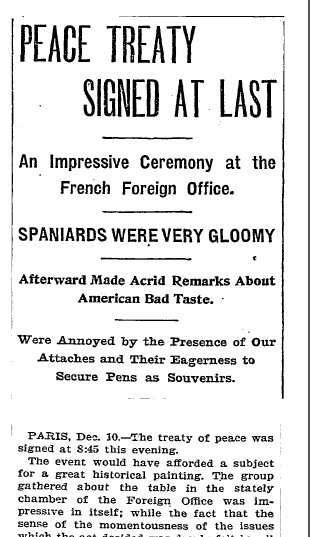 |
| News Item about the Treaty of Paris. Photo courtesy of www.tumblr.com |
Believing that the Treaty of
Paris was an imperialist gesture on the part of the United States, Carnegie tried
to secure independence for the Philippines. Accordingly, he was so passionate
about this cause that he offered $20 million to purchase the independence
of the Philippines.[vi]
Evidences for such an offer include the following accounts:
“Carnegie gained much good
will in 1898 when he offered $20 million to the government of the Philippines.
He was an opponent of the American acquisition of the islands and hoped the
Filipinos could purchase their independence.”[vii]
“Some prominent Americans,
such as former President Grover Cleveland, the writer Mark Twain and
industrialist Andrew Carnegie, also opposed the ratification. The latter even
offered to buy the Philippines for US $20 million and give it to the Filipinos
so that they could be free; he believed the U.S. should exercise global
economic power but avoid annexing colonies.”[viii]
“That Andrew Carnegie’s
opposition to Philippine annexation was strong enough to lead him to make an
offer of $20,000,000 to prevent it has just been disclosed in an article
written by President George F. Seward of the Fidelity and Casualty Company for
the monthly bulletin published by that company. Some time ago Mr. Carnegie,
in an article in The North American Review, referred to an interview he had
with President McKinley at the time the occupation of the Philippines by the
United States was under discussion, after which interview President McKinley,
he says, remarked that Mr. Carnegie “did not understand the question.” A fuller
account of this interview is now made public by Mr. Seward, to whom the facts
were given by Mr. Carnegie. Mr. Seward says: 'Mr. Carnegie went to Mr.
McKinley when the Spanish treaty was pending, and said to him that America was
in face of war in the Philippines; that our people and the Filipinos would soon
be killing one another, and he asked to be sent to Manila with the fullest
authority to declare that America desired good things for the little brown men
and would soon recognize their independence. He said to Mr. McKinley further,
that, he had the matter so much at heart that, if sent on such mission, he
would himself pay the $20,000,000 called by the treaty.' According to Mr. Seward,
Mr. Carnegie told him of this conversation shortly before he sailed for Europe
a few weeks ago.”[ix]
Carnegie explained his
opposition to the annexation of the Philippines by the United States in an
article that was originally published in the North American Review in August 1898. The article was entitled
“Distant Positions: The Parting of the Ways”. Excerpts are presented below.
“Twice
only have the American people been called upon to decide a question of such
vital import as that now before them.
“Is
the Republic, the apostle of Triumphant Democracy, of the rule of the people,
to abandon her political creed and endeavor to establish in other lands the
rule of the foreigner over the people, Triumphant Despotism?
“Is
the Republic to remain one homogeneous whole, one united people, or to become a
scattered and disjointed aggregate of widely separated and alien races?
“Is she to continue the task of developing her vast continent until it holds a population as great as that of Europe, all Americans, or to abandon that destiny to annex, and to attempt to govern, other far distant parts of the world as outlying possessions, which can never be integral parts of the Republic?
“Is she to continue the task of developing her vast continent until it holds a population as great as that of Europe, all Americans, or to abandon that destiny to annex, and to attempt to govern, other far distant parts of the world as outlying possessions, which can never be integral parts of the Republic?
“Is
she to exchange internal growth and advancement for the development of external
possessions which can never be really hers in any fuller sense than India is
British or Cochin China French? Such is the portentous question of the day. Two
equally important questions the American people have decided wisely, and their
flag now waves over the greater portion of the English-speaking race; their
country is the richest of all countries, first in manufactures, in mining, and
in commerce (home and foreign), first this year also in exports. But, better
than this, the average condition of its people in education and in living is
the best. The luxuries of the masses in other lands are the necessaries of life
in ours.
“There
are two kinds of national possessions, one colonies, the other dependencies. In
the former we establish and reproduce our own race. Thus Britain has peopled
Canada and Australia with English-speaking people, who have naturally adopted
our ideas of self-government.
“With
dependencies it is otherwise. The most grievous burden which Britain has upon
her shoulders is that of India, for there it is impossible for our race to
grow. The child of English-speaking parents must be removed and reared in
Britain. The British Indian official must have long respites in his native
land. India means death to our race. The characteristic feature of a dependency
is that the acquiring power cannot reproduce its own race there.
“If
we could establish colonies of Americans, and grow Americans in any part of the
world now unpopulated and unclaimed by any of the great powers, and thus follow
the example of Britain, heart and mind might tell us that we should have to
think twice, yea, thrice, before deciding adversely. Even then our decision
should be adverse; but there is at present no such question before us. What we
have to face is the question whether we should embark upon the difficult and
dangerous policy of undertaking the government of alien races in lands where it
is impossible for our own race to be produced.
“As
long as we remain free from distant possessions we are impregnable against
serious attack; yet, it is true, we have to consider what obligations may fall
upon us of an international character requiring us to send our forces to points
beyond our own territory. Up to this time we have disclaimed all intention to
interfere with affairs beyond our own continent, and only claimed the right to
watch over American interests according to the Monroe Doctrine, which is now
firmly established. This carries with it serious responsibilities, no doubt,
which we cannot escape. European nations must consult us upon territorial
questions pertaining to our continent, but this makes no tremendous demand upon
our military or naval forces. We are at home, as it were, near our base, and
sure of the support of the power in whose behalf and on whose request we may
act. If it be found essential to possess a coaling-station at Puerto Rico for
future possible, though not probable, contingencies, there is no insuperable
objection. Neither would the control of the West Indies be alarming if pressed
upon us by Britain, since the islands are small and the populations must remain
insignificant and without national aspirations. Besides, they are upon our own
shores, American in every sense. Their defense by us would be easy. No protest
need be entered against such legitimate and peaceful expansion in our own
hemisphere, should events work in that direction. I am no "Little"
American, afraid of growth, either in population or territory, provided always
that the new territory be American, and that it will produce Americans, and not
foreign races bound in time to be false to the Republic in order to be true to
themselves.
“To
reduce it to the concrete, the question is: Shall we attempt to establish
ourselves as a power in the far East and possess the Philippines for glory? The
glory we already have, in Dewey's victory overcoming the power of Spain in a
manner which adds one more to the many laurels of the American navy, which,
from its infancy till now, has divided the laurels with Britain upon the sea.
The Philippines have about seven and a half millions of people, composed of
races bitterly hostile to one another, alien races, ignorant of our language
and institutions. Americans cannot be grown there. The islands have been
exploited for the benefit of Spain, against whom they have twice rebelled, like
the Cubans. But even Spain has received little pecuniary benefit from them. The
estimated revenue of the Philippines in 1894-95 was £2,715,980, the expenditure
being £2,656,026, leaving a net result of about $300,000. The United States
could obtain even this trifling sum from the inhabitants only by oppressing
them as Spain has done. But, if we take the Philippines, we shall be forced to
govern them as generously as Britain governs her dependencies, which means that
they will yield us nothing, and probably be a source of annual expense.
Certainly they will be a grievous drain upon revenue if we consider the
enormous army and navy which we shall be forced to maintain upon their account.
“Let
another phase of the question be carefully weighed. Europe is to-day an armed
camp, not chiefly because the home territories of its various nations are
threatened, but because of fear of aggressive action upon the part of other
nations touching outlying "possessions." France resents British
control of Egypt, and is fearful of its West African possessions; Russia seeks
Chinese territory, with a view to expansion to the Pacific; Germany also seeks
distant possessions; Britain, who has acquired so many dependencies, is so
fearful of an attack upon them that this year she is spending nearly eighty
millions of dollars upon additional war-ships, and Russia, Germany, and France
follow suit. Japan is a new element of anxiety; and by the end of the year it
is computed she will have sixty-seven formidable ships of war. The naval powers
of Europe, and Japan also, are apparently determined to be prepared for a
terrific struggle for possessions in the far East, close to the Philippines --
and why not for these islands themselves? Into this vortex the Republic is
cordially invited to enter by those powers who expect her policy to be of
benefit to them, but her action is jealously watched by those who fear that her
power might be used against them.
“It
has never been considered the part of wisdom to thrust one's hand into the
hornet's nest, and it does seem as if the United States must lose all claim to
ordinary prudence and good sense if she enter this arena and become involved in
the intrigues and threats of war which make Europe an armed camp.
“What
it means to enter the list of military and naval powers having foreign
possessions may be gathered from the following considerations. First, look at
our future navy. If it is only to equal that of France it means fifty-one
battle-ships; if of Russia, forty battle-ships. If we cannot play the game
without being at least the equal of any of our rivals, then eighty battle-ships
is the number Britain possesses. We now have only four, with five building.
Cruisers, armed and unarmed, swell the number threefold, Britain having two
hundred and seventy-three ships of the line built or ordered, with three
hundred and eight torpedo-boats in addition; France having one hundred and
thirty-four ships of the line and two hundred and sixty-nine torpedo-boats. All
these nations are adding ships rapidly. Every armor- and gun-making plant in
the world is busy night and day. Ships are indispensable, but recent experience
shows that soldiers are equally so. While the immense armies of Europe need not
be duplicated, yet we shall certainly be too weak unless our army is at least
twenty times what it has been -- say five hundred thousand men. Even then we
shall be powerless as against any one of three of our rivals -- Germany,
France, and Russia.
“This
drain upon the resources of these countries has become a necessity from their
respective positions, largely as graspers for foreign possessions. The United
States to-day, happily, has no such necessity, her neighbors being powerless
against her, since her possessions are concentrated and her power is one solid
mass.
“To-day
two great powers in the world are compact, developing themselves in peace
throughout vast conterminous territories. When war threatens they have no
outlying possessions which can never be really "possessed," but which
they are called upon to defend. They fight upon the exposed edge only of their
own soil in case of attack, and are not only invulnerable, but they could not
be more than inconvenienced by the world in arms against them. These powers are
Russia and the United States. The attempt of Britain to check Russia, if the
wild counsels of Mr. Chamberlain were followed, could end in nothing but
failure. With the irresistible force of the glacier, Russia moves upon the
plains below. Well for Russia, and well for the world, is her advance over
pagan China, better even for Britain from the standpoint of business, for every
Russian to-day trades as much with Britain as do nine Chinamen. Britain, France,
Germany, Belgium, Spain, are all vulnerable, having departed from the sagacious
policy of keeping possessions and power concentrated. Should the United States
depart from this policy, she also must be so weakened in consequence as never
to be able to play the commanding part in the world, disjointed, that she can
play whenever she desires if she remain compact.
“Whether
the United States maintain its present unique position of safety, or forfeit it
through acquiring foreign possessions, is to be decided by its action in regard
to the Philippines; for, fortunately, the independence of Cuba is assured; for
this the Republic has proclaimed to the world that she has drawn the sword. But
why should the less than two millions of Cuba receive national existence and
the seven and a half millions of the Philippines be denied it? The United
States, thus far in their history, have no page reciting self-sacrifice made
for others; all their gains have been for themselves. This void is now to be
grandly filled. The page which recites the resolve of the Republic to rid her
neighbor, Cuba, from the foreign possessor will grow brighter with the passing
centuries, which may dim many pages now deemed illustrious. Should the coming
American be able to point to Cuba and the Philippines rescued from foreign
domination and enjoying independence won for them by his country and given to
them without money and without price, he will find no citizen of any other land
able to claim for his country services so disinterested and so noble.
“We
repeat, there is no power in the world that could do more than inconvenience
the United States by attacking its fringe, which is all that the world combined
could do, so long as our country is not compelled to send its forces beyond its
own compact shores to defend worthless possessions. If our country were
blockaded by the united powers of the world for years, she would emerge from
the embargo richer and stronger, and with her own resources more completely
developed. We have little to fear from external attack. No thorough blockade of
our enormous seaboard is possible; but even if it were, the few indispensable
articles not produced by ourselves (if there were any such) would reach us by
way of Mexico or Canada at slightly increased cost.
“From
every point of view we are forced to the conclusion that the past policy of the
Republic is her true policy for the future; for safety, for peace, for
happiness, for progress, for wealth, for power -- for all that makes a nation
blessed.
“Not
till the war-drum is silent, and the day of calm peace returns, can the issue
be soberly considered.
“Twice
have the American people met crucial issues wisely, and in the third they are
not to fail.”
Inspite of the strong and loud opposition by the league, the United States Senate ratified the treaty. Two days before the ratification, on February 4, 1899, “fighting broke out between American forces and Filipino nationalists led by Emilio Aguinaldo who sought independence rather than a change in colonial rulers.”[x]
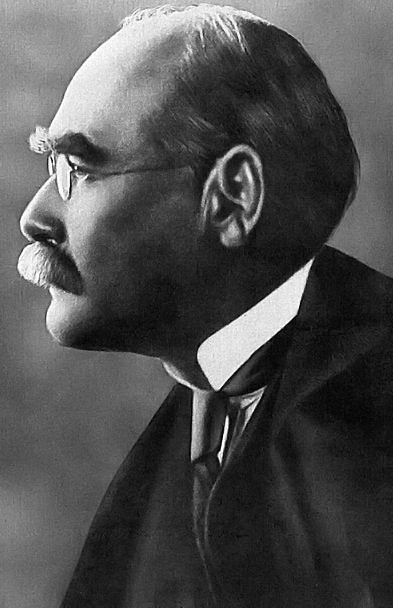 |
| Rudyard Kipling (public domain) |
“Take up the White
Man’s burden—
Send forth the best
ye breed—
Go send your sons to
exile
To serve your captives'
need
To wait in heavy
harness
On fluttered folk and
wild—
Your new-caught,
sullen peoples,
Half devil and half
child
Take up the White
Man’s burden
In patience to abide
To veil the threat of
terror
And check the show of
pride;
By open speech and simple
An hundred times made
plain
To seek another’s
profit
And work another’s
gain
Take up the White
Man’s burden—
And reap his old
reward:
The blame of those ye
better
The hate of those ye
guard—
The cry of hosts ye
humour
(Ah slowly) to the
light:
"Why brought ye
us from bondage,
“Our loved Egyptian
night?”
Take up the White
Man’s burden-
Have done with
childish days-
The lightly proffered
laurel,
The easy, ungrudged
praise.
Comes now, to search
your manhood
Through all the
thankless years,
Cold-edged with
dear-bought wisdom,
The judgment of your
peers!”[xi]
One of the replies to Kipling’s poem was a poem
entitled “The Black Man’s Burden”:
“Pile on the Black
Man’s Burden.
'Tis nearest at your
door;
Why heed long
bleeding Cuba,
or dark Hawaii’s
shore?
Hail ye your fearless
armies,
Which menace feeble
folks
Who fight with clubs
and arrows
and brook your
rifle’s smoke.
Pile on the Black
Man’s Burden
His wail with
laughter drown
You’ve sealed the Red
Man’s problem,
And will take up the
Brown,
In vain ye seek to
end it,
With bullets, blood
or death
Better by far defend
it
With honor’s holy
breath.”
The answer was written by African-American
clergyman and editor H. T. Johnson. It was published in April 1899. An
organization called “Black Man’s Burden Association” was also formed “with the
goal of demonstrating that mistreatment of brown people in the Philippines was
an extension of the mistreatment of black Americans at home.”[xii]
Admittedly, the Americans
were somewhat divided on the decision to colonize the Philippines. An article
from the U.S. Department of State explained that:
“The decision by U.S.
policymakers to annex the Philippines was not without domestic controversy.
Americans who advocated annexation evinced a variety of motivations: desire for
commercial opportunities in Asia, concern that the Filipinos were incapable of
self-rule, and fear that if the United States did not take control of the
islands, another power (such as Germany or Japan) might do so. Meanwhile,
American opposition to U.S. colonial rule of the Philippines came in many
forms, ranging from those who thought it morally wrong for the United States to
be engaged in colonialism, to those who feared that annexation might eventually
permit the non-white Filipinos to have a role in American national government.
Others were wholly unconcerned about the moral or racial implications of
imperialism and sought only to oppose the policies of President William
McKinley's administration.”[xiii]
 |
| U.S. President William McKinley. Photo courtesy of www.loc.gov |
President William McKinley,
however, defended “his decision to support the annexation of the Philippines.”
He explained:
“I have been
criticized a good deal about the Philippines, but don’t deserve it. The truth
is I didn’t want the Philippines, and when they came to us, as a gift from the
gods, I did not know what to do with them. When the Spanish War broke out,
Dewey was at Hong Kong, and I ordered him to go to Manila and to capture or
destroy the Spanish fleet, and he had to; because, if defeated, he had no place
to refit on that side of the globe, and if the Dons were victorious, they would
likely cross the Pacific and ravage our Oregon and California coasts. And so he
had to destroy the Spanish fleet, and did it! But that was as far as I thought
then.
“When next I realized
that the Philippines had dropped into our laps I confess I did not know what to
do with them. I sought counsel from all sides—Democrats as well as
Republicans—but got little help. I thought first we would take only Manila;
then Luzon; then other islands, perhaps, also. I walked the floor of the White
House night after night until midnight; and I am not ashamed to tell you,
gentlemen, that I went down on my knees and prayed Almighty God for light and
guidance more than one night. And one night late it came to me this way—I don't
know how it was, but it came: (1) That we could not give them back to
Spain—that would be cowardly and dishonorable; (2) that we could not turn them
over to France, or Germany—our commercial rivals in the Orient—that would be
bad business and discreditable; (3) that we could not leave them to
themselves—they were unfit for self-government—and they would soon have anarchy
and misrule over there worse than Spain's was; and (4) that there was nothing
left for us to do but to take them all, and to educate the Filipinos, and uplift
and civilize and Christianize them, and by God's grace do the very best we
could by them, as our fellow-men for whom Christ also died. And then I went to
bed, and went to sleep, and slept soundly, and the next morning I sent for the
chief engineer of the War Department (our map-maker), and I told him to put the
Philippines on the map of the United States [pointing to a large map on the
wall of his office], and there they are, and there they will stay while I am President!”[xiv]
Going back to the question posed
in this article, did Andrew Carnegie offer $20 million to save the Philippines?
David Nasaw, author of the 2006 book entitled “Andrew Carnegie” ventured an
answer:
“…A vote for the treaty was
a vote to ratify the sale of the Philippines to the United States, preliminary
to formal annexation.
“The treaty was ratified by
a one-vote margin when Bryan refused to marshal any votes against it. In the
years to come, it would be claimed (without proof) that soon after the
ratification vote, Carnegie visited with President McKinley and offered to buy
the Philippines for $20 million (the amount the Americans had given Spain) and
set the islands free. The claim is not credible. Carnegie did not have anywhere
near that sum to spend – and would not until he sold Carnegie Steel, an event
that was several years in the future. He never mentioned any such offer in his Autobiography or any of his letters, but
he never denied the rumor either, preferring perhaps to let it stand as
testimony to his commitment to peace.”[xv]
[i]
See http://www.celebritynetworth.com/articles/entertainment-articles/25-richest-people-lived-inflation-adjusted/#!/4-andrew-carnegie-net-worth-310-billion_1016/
(accessed at 3:22 a.m. on April 28, 2013)
[ii]
See http://www.americaslibrary.gov/aa/carnegie/aa_carnegie_subj.html
(accessed at 12:30 a.m. on April 28, 2013) and http://www.history.com/topics/andrew-carnegie
(accessed at 12:35 a.m. on April 28, 2013)
[v]
Ibid.
[vi]
http://www.pbs.org/wgbh/amex/carnegie/timeline/timeline2.html
(Accessed 2:13 a.m., April 28, 2013)
[viii]
http://philippineamericanwar.webs.com/usratifiesparistreaty.htm
(Accessed 2:21 a.m., April 28, 2013)
[ix] http://query.nytimes.com/gst/abstract.html?res=F00D12FE3A591B728DDDAF0994DD405B828CF1D3
(Accessed at 2:46 a.m. on April 28, 2013)
[xi]
Source: Rudyard Kipling, “The White Man’s Burden: The United States & The
Philippine Islands, 1899.” Rudyard Kipling’s Verse: Definitive Edition (Garden
City, New York: Doubleday, 1929). http://historymatters.gmu.edu/d/5478
(Accessed 2:10 a.m., April 28, 2013)
[xii]
Source: H.T. Johnson, “The Black Man’s Burden,” Voice of Missions, VII
(Atlanta: April 1899), 1. Reprinted in Willard B. Gatewood, Jr., Black
Americans and the White Man’s Burden, 1898–1903 (Urbana: University of Illinois
Press), 1975, 183–184. http://historymatters.gmu.edu/d/5476
(Accessed 2:05 a.m., April 28, 2013)
[xiii]
http://2001-2009.state.gov/r/pa/ho/time/ip/87722.htm
(Accessed at 1:54 a.m. on April 28, 2013)
[xiv]
William McKinley. Annexing the
Philippines. Copyright © by The McGraw-Hill Companies, Inc. Also
refer to General James Rusling, “Interview with President William McKinley,” The
Christian Advocate 22 January 1903. http://historymatters.gmu.edu/blackboard/mckinley.html
(Accessed 2:00 a.m., April 28, 2013)
[i]
See http://www.celebritynetworth.com/articles/entertainment-articles/25-richest-people-lived-inflation-adjusted/#!/4-andrew-carnegie-net-worth-310-billion_1016/
(accessed at 3:22 a.m. on April 28, 2013)
[ii]
See http://www.americaslibrary.gov/aa/carnegie/aa_carnegie_subj.html
(accessed at 12:30 a.m. on April 28, 2013) and http://www.history.com/topics/andrew-carnegie
(accessed at 12:35 a.m. on April 28, 2013)
[v]
Ibid.
[vi]
http://www.pbs.org/wgbh/amex/carnegie/timeline/timeline2.html
(Accessed 2:13 a.m., April 28, 2013)
[viii]
http://philippineamericanwar.webs.com/usratifiesparistreaty.htm
(Accessed 2:21 a.m., April 28, 2013)
[ix] http://query.nytimes.com/gst/abstract.html?res=F00D12FE3A591B728DDDAF0994DD405B828CF1D3
(Accessed at 2:46 a.m. on April 28, 2013)
[xi]
Source: Rudyard Kipling, “The White Man’s Burden: The United States & The
Philippine Islands, 1899.” Rudyard Kipling’s Verse: Definitive Edition (Garden
City, New York: Doubleday, 1929). http://historymatters.gmu.edu/d/5478
(Accessed 2:10 a.m., April 28, 2013)
[xii]
Source: H.T. Johnson, “The Black Man’s Burden,” Voice of Missions, VII
(Atlanta: April 1899), 1. Reprinted in Willard B. Gatewood, Jr., Black
Americans and the White Man’s Burden, 1898–1903 (Urbana: University of Illinois
Press), 1975, 183–184. http://historymatters.gmu.edu/d/5476
(Accessed 2:05 a.m., April 28, 2013)
[xiii]
http://2001-2009.state.gov/r/pa/ho/time/ip/87722.htm
(Accessed at 1:54 a.m. on April 28, 2013)
[xiv]
William McKinley. Annexing the
Philippines. Copyright © by The McGraw-Hill Companies, Inc. Also
refer to General James Rusling, “Interview with President William McKinley,” The
Christian Advocate 22 January 1903. http://historymatters.gmu.edu/blackboard/mckinley.html
(Accessed 2:00 a.m., April 28, 2013)
Tuesday, April 23, 2013
Assisted Natural Regeneration
 |
| Poblacion Norte, Batuan, Bohol |
In 1992, we
started removing the Imperata or cogon grass that grew at the side of the
hill where our house is located. We did this for safety reasons. We feared that
fire would engulf the dry cogon grass, especially during dry season. This would
put our family in danger because our house is located at the lower portion of
the hillside.
In 2012, our hill
side is now covered with trees – mostly mahogany and native trees like Molave or tugas. By removing the cogon grass, we
hastened the natural successional processes.
According to the Food and Agriculture Office (FAO), assisted natural regeneration (ANR) “is a method for enhancing the establishment of secondary forest from degraded grassland and shrub vegetation by protecting and nurturing the mother trees and their wildlings inherently present in the area”. The ANR:
According to the Food and Agriculture Office (FAO), assisted natural regeneration (ANR) “is a method for enhancing the establishment of secondary forest from degraded grassland and shrub vegetation by protecting and nurturing the mother trees and their wildlings inherently present in the area”. The ANR:
- Is a cost efficient way of regenerating forest.
- Provides potential livelihood opportunities for communities.
- Contributes to strengthening biodiversity,
- Provides hunting areas.
- Increases carbon sequestration and carbon sinks which contribute to climate change mitigation.
Reading: Advancing Assisted Natural Regeneration
(ANR) in Asia and the Pacific
Sunday, April 21, 2013
Human Needs as Human Rights
by Alan S. Cajes
Human beings have needs that must be met and satisfied to ensure human development. Moreover, the needs of human beings have ontological basis, which quite simply means that as long as human beings are human beings, their needs cannot be taken away from them. And should not be disregarded. As such, needs are natural entitlements. Needs are recognized as human rights.
Human right is “that which is due to a person” based on legal, social or ethical principles. It is the object of justice, which is commonly understood as “giving that which is due to a person”. A violation of a person’s right is therefore tantamount to a commission of an injustice. Put differently, the fulfillment of a person’s right is equivalent to an act of doing justice. Within this framework, the goal of development can be understood as fulfilling human rights or doing justice.
What this implies is that development per se is demandable. Within the framework of national development, the instrumentalities of the State can be held accountable if the demand of justice is not fulfilled. Example: because poverty violates human rights or hinders a person from exercising his or her freedoms, the instrumentalities of the state that are responsible for such poverty are liable for committing an injustice.
Reading: The Universal Declaration of Human Rights
Preamble
Whereas recognition of the inherent dignity and of the equal and inalienable rights of all members of the human family is the foundation of freedom, justice and peace in the world,
Whereas disregard and contempt for human rights have resulted in barbarous acts which have outraged the conscience of mankind, and the advent of a world in which human beings shall enjoy freedom of speech and belief and freedom from fear and want has been proclaimed as the highest aspiration of the common people,
Whereas it is essential, if man is not to be compelled to have recourse, as a last resort, to rebellion against tyranny and oppression, that human rights should be protected by the rule of law,
Whereas it is essential to promote the development of friendly relations between nations,
Whereas the peoples of the United Nations have in the Charter reaffirmed their faith in fundamental human rights, in the dignity and worth of the human person and in the equal rights of men and women and have determined to promote social progress and better standards of life in larger freedom,
Whereas Member States have pledged themselves to achieve, in co-operation with the United Nations, the promotion of universal respect for and observance of human rights and fundamental freedoms,
Whereas a common understanding of these rights and freedoms is of the greatest importance for the full realization of this pledge,
Now, Therefore THE GENERAL ASSEMBLY proclaims THIS UNIVERSAL DECLARATION OF HUMAN RIGHTS as a common standard of achievement for all peoples and all nations, to the end that every individual and every organ of society, keeping this Declaration constantly in mind, shall strive by teaching and education to promote respect for these rights and freedoms and by progressive measures, national and international, to secure their universal and effective recognition and observance, both among the peoples of Member States themselves and among the peoples of territories under their jurisdiction.
Article 1.
All human beings are born free and equal in dignity and rights. They are endowed with reason and conscience and should act towards one another in a spirit of brotherhood.
Article 2.
Everyone is entitled to all the rights and freedoms set forth in this Declaration, without distinction of any kind, such as race, colour, sex, language, religion, political or other opinion, national or social origin, property, birth or other status. Furthermore, no distinction shall be made on the basis of the political, jurisdictional or international status of the country or territory to which a person belongs, whether it be independent, trust, non-self-governing or under any other limitation of sovereignty.
Article 3.
Everyone has the right to life, liberty and security of person.
Article 4.
No one shall be held in slavery or servitude; slavery and the slave trade shall be prohibited in all their forms.
Article 5.
No one shall be subjected to torture or to cruel, inhuman or degrading treatment or punishment.
Article 6.
Everyone has the right to recognition everywhere as a person before the law.
Article 7.
All are equal before the law and are entitled without any discrimination to equal protection of the law. All are entitled to equal protection against any discrimination in violation of this Declaration and against any incitement to such discrimination.
Article 8.
Everyone has the right to an effective remedy by the competent national tribunals for acts violating the fundamental rights granted him by the constitution or by law.
Article 9.
No one shall be subjected to arbitrary arrest, detention or exile.
Article 10.
Everyone is entitled in full equality to a fair and public hearing by an independent and impartial tribunal, in the determination of his rights and obligations and of any criminal charge against him.
Article 11.
(1) Everyone charged with a penal offence has the right to be presumed innocent until proved guilty according to law in a public trial at which he has had all the guarantees necessary for his defence.
(2) No one shall be held guilty of any penal offence on account of any act or omission which did not constitute a penal offence, under national or international law, at the time when it was committed. Nor shall a heavier penalty be imposed than the one that was applicable at the time the penal offence was committed.
Article 12.
No one shall be subjected to arbitrary interference with his privacy, family, home or correspondence, nor to attacks upon his honour and reputation. Everyone has the right to the protection of the law against such interference or attacks.
Article 13.
(1) Everyone has the right to freedom of movement and residence within the borders of each state.
(2) Everyone has the right to leave any country, including his own, and to return to his country.
Article 14.
(1) Everyone has the right to seek and to enjoy in other countries asylum from persecution.
(2) This right may not be invoked in the case of prosecutions genuinely arising from non-political crimes or from acts contrary to the purposes and principles of the United Nations.
Article 15.
(1) Everyone has the right to a nationality.
(2) No one shall be arbitrarily deprived of his nationality nor denied the right to change his nationality.
Article 16.
(1) Men and women of full age, without any limitation due to race, nationality or religion, have the right to marry and to found a family. They are entitled to equal rights as to marriage, during marriage and at its dissolution.
(2) Marriage shall be entered into only with the free and full consent of the intending spouses.
(3) The family is the natural and fundamental group unit of society and is entitled to protection by society and the State.
Article 17.
(1) Everyone has the right to own property alone as well as in association with others.
(2) No one shall be arbitrarily deprived of his property.
Article 18.
Everyone has the right to freedom of thought, conscience and religion; this right includes freedom to change his religion or belief, and freedom, either alone or in community with others and in public or private, to manifest his religion or belief in teaching, practice, worship and observance.
Article 19.
Everyone has the right to freedom of opinion and expression; this right includes freedom to hold opinions without interference and to seek, receive and impart information and ideas through any media and regardless of frontiers.
Article 20.
(1) Everyone has the right to freedom of peaceful assembly and association.
(2) No one may be compelled to belong to an association.
Article 21.
(1) Everyone has the right to take part in the government of his country, directly or through freely chosen representatives.
(2) Everyone has the right of equal access to public service in his country.
(3) The will of the people shall be the basis of the authority of government; this will shall be expressed in periodic and genuine elections which shall be by universal and equal suffrage and shall be held by secret vote or by equivalent free voting procedures.
Article 22.
Everyone, as a member of society, has the right to social security and is entitled to realization, through national effort and international co-operation and in accordance with the organization and resources of each State, of the economic, social and cultural rights indispensable for his dignity and the free development of his personality.
Article 23.
(1) Everyone has the right to work, to free choice of employment, to just and favourable conditions of work and to protection against unemployment.
(2) Everyone, without any discrimination, has the right to equal pay for equal work.
(3) Everyone who works has the right to just and favourable remuneration ensuring for himself and his family an existence worthy of human dignity, and supplemented, if necessary, by other means of social protection.
(4) Everyone has the right to form and to join trade unions for the protection of his interests.
Article 24.
Everyone has the right to rest and leisure, including reasonable limitation of working hours and periodic holidays with pay.
Article 25.
(1) Everyone has the right to a standard of living adequate for the health and well-being of himself and of his family, including food, clothing, housing and medical care and necessary social services, and the right to security in the event of unemployment, sickness, disability, widowhood, old age or other lack of livelihood in circumstances beyond his control.
(2) Motherhood and childhood are entitled to special care and assistance. All children, whether born in or out of wedlock, shall enjoy the same social protection.
Article 26.
(1) Everyone has the right to education. Education shall be free, at least in the elementary and fundamental stages. Elementary education shall be compulsory. Technical and professional education shall be made generally available and higher education shall be equally accessible to all on the basis of merit.
(2) Education shall be directed to the full development of the human personality and to the strengthening of respect for human rights and fundamental freedoms. It shall promote understanding, tolerance and friendship among all nations, racial or religious groups, and shall further the activities of the United Nations for the maintenance of peace.
(3) Parents have a prior right to choose the kind of education that shall be given to their children.
Article 27.
(1) Everyone has the right freely to participate in the cultural life of the community, to enjoy the arts and to share in scientific advancement and its benefits.
(2) Everyone has the right to the protection of the moral and material interests resulting from any scientific, literary or artistic production of which he is the author.
Article 28.
Everyone is entitled to a social and international order in which the rights and freedoms set forth in this Declaration can be fully realized.
Article 29.
(1) Everyone has duties to the community in which alone the free and full development of his personality is possible.
(2) In the exercise of his rights and freedoms, everyone shall be subject only to such limitations as are determined by law solely for the purpose of securing due recognition and respect for the rights and freedoms of others and of meeting the just requirements of morality, public order and the general welfare in a democratic society.
(3) These rights and freedoms may in no case be exercised contrary to the purposes and principles of the United Nations.
Article 30.
Nothing in this Declaration may be interpreted as implying for any State, group or person any right to engage in any activity or to perform any act aimed at the destruction of any of the rights and freedoms set forth herein.
Subscribe to:
Posts (Atom)